
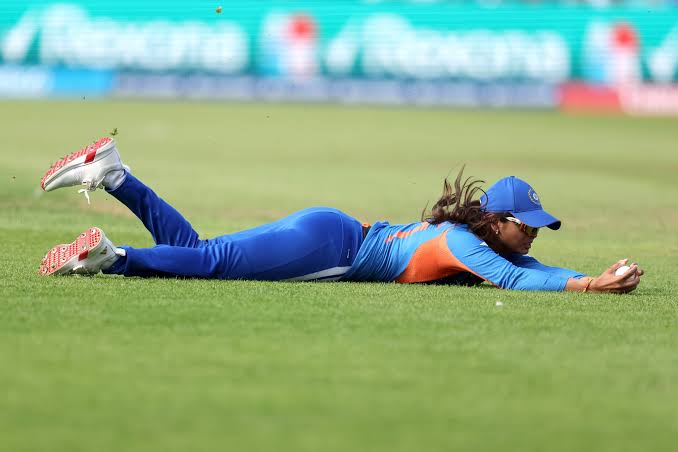
One catch. 112 million video views. An audience far beyond cricket.
On 14 June 2026 Shreyanka Patil took a diving catch for India against Pakistan at the ICC Women’s T20 World Cup. It became the tournament’s most-viewed clip on the ICC’s Facebook and Instagram channels.
The business question is larger than the catch: how can women’s sport organisations turn viral attention into sustainable commercial value? The answer connects digital distribution, media rights, athlete branding, sponsorship activation and measurable return on investment (ROI). Patil’s moment shows what virality offers and where it stops.
The viral catch: 112 million views and a global audience
India beat Pakistan by 64 runs at Edgbaston, Birmingham. In the 15th over of Pakistan’s chase, Rameen Shamim advanced to left-arm spinner Shree Charani and got a thick outside edge. Patil, at backward point, sprinted to her right, dived and held the ball (ESPNcricinfo, 2026).
The ICC later reported 112 million views of the clip across its Facebook and Instagram channels (ICC, 2026a).
The scale of the wider tournament provides important context. The India–Pakistan match generated more than 77 million global viewing hours and attracted 18,814 spectators. Across the tournament, the ICC recorded 3.2 billion views on its digital platforms, with more than 1.1 billion additional views reported through its Creator Club. Total tournament viewing hours reached 471 million.
The tournament also generated a reported USD 93.8 million in UK impact.
These figures demonstrate the tournament’s substantial audience and economic significance. However, video views, viewing hours, attendance and economic impact represent different performance measures and should not be combined or interpreted interchangeably.
Two features of the data matter commercially. The clip alone produced approximately 3.5% of all reported views on ICC platforms across the 33-match tournament, based on a comparison of 112 million and 3.2 billion. It also reportedly passed 100 million views before the 19th match (Storyboard18, 2026), indicating that substantial attention accumulated relatively early in the competition.
Digital visibility and commercial profitability are not the same thing. The ICC has published view figures for the clip. It has not published revenue attributable specifically to that moment.
Why did Shreyanka Patil’s catch go viral?
Sporting excellence alone rarely explains a viral moment. Four mechanisms offer an explanation, each supported by relevant academic research.
1. High-arousal emotion
Berger and Milkman (2012) analysed three months of New York Times articles and found that content evoking high-arousal emotions, including awe, anger and anxiety, was more likely to be shared. Content associated with low-arousal emotions, such as sadness, was shared less frequently.
A full-stretch diving catch can generate awe within seconds. Its outcome is visually clear even to someone unfamiliar with cricket.
This provides a plausible explanation for why Patil’s catch could attract attention beyond established cricket audiences.
2. Broadcast scale ahead of person-to-person sharing
Goel et al. (2016) examined approximately one billion diffusion events on Twitter. Their research found that online popularity was strongly associated with the size of major broadcast events, while extensive person-to-person sharing chains were relatively uncommon.
The India–Pakistan match generated more than 77 million viewing hours, and the clip was distributed through the ICC’s established digital channels.
A plausible explanation is that institutional distribution, amplified by platform recommendations, delivered a substantial proportion of the views.
However, the ICC has not published the clip’s referral or sharing data, so the relative contribution of each distribution mechanism cannot be established.
3. The athlete as a brand
Arai, Ko and Ross (2014) conceptualise athlete brand image through three dimensions: athletic performance, attractive appearance and marketable lifestyle.
A viral sporting highlight contributes most directly to awareness of athletic performance.
Recognition can develop into endorsement opportunities when an athlete and their management establish a consistent personal narrative, appropriate commercial positioning and sustained audience engagement.
For women’s sport organisations, athlete branding is also strategically important because individual recognition can contribute to fan engagement, competition visibility and sponsorship opportunities.
However, increased visibility does not automatically translate into endorsement income.
4. Direct distribution around the media gatekeeper
Cooky et al. (2021) found that women’s sport received 5.4% of airtime on US television sports news and highlights programmes in 2019, compared with approximately 5% in 1989.
Digital channels allow rights holders to distribute content directly rather than relying exclusively on traditional television coverage.
The ICC supported the 2026 tournament with coverage in 14 languages and a Creator Club comprising more than 80 creators from nine countries (ICC, 2026a).
This distribution infrastructure provided opportunities to reach audiences across markets and languages.
A caution on the metric
Social media video views do not necessarily represent unique individuals. Platform-specific definitions can include initial plays and repeated viewing.
Meta’s approach to video-view measurement means that a large number of reported views should not automatically be interpreted as an equivalent number of individual viewers (Fanpage Karma, n.d.).
Consequently, the 112 million figure is an indicator of video consumption, rather than a confirmed count of distinct people reached.
The business of virality: who captures the commercial value?
Value in sport is co-created by a network of participants, including rights holders, athletes, sponsors, media organisations, platforms and fans (Woratschek, Horbel and Popp, 2014).
However, creating value and capturing value are different processes.
The commercial benefits associated with Patil’s viral catch depend on the rights, contractual relationships and commercial capabilities of different stakeholders.
Event organiser and rights holder
The International Cricket Council controls relevant tournament media rights, distribution channels and sponsorship inventory.
The clip’s 112 million views contributed to the ICC’s reported 3.2 billion platform views during the tournament.
The ICC also reported that partner investment at least doubled compared with the 2024 edition (ICC, 2026a).
These figures illustrate the broader commercial growth of the competition, although they do not establish how much revenue was directly generated by the catch.
The athlete
Shreyanka Patil controls elements of her personal brand, including her name, image and personal communication channels, subject to applicable contractual arrangements.
Her viral performance may strengthen future commercial negotiations and endorsement opportunities.
However, publicly available evidence does not establish how much additional income, if any, she earned directly because of the clip.
The athlete’s personal image rights must also be distinguished from the rights governing the tournament’s match footage.
Athlete sponsors
KLF Nirmal reportedly announced Patil as its Karnataka brand ambassador on 11 June 2026, three days before the catch (Adgully, 2026).
This provides an example of commercial association established before an athlete experiences an exceptionally visible sporting moment.
Nevertheless, the commercial return on that sponsorship cannot be assessed without campaign-performance information.
Tournament partners
Commercial partners can benefit from association with a high-profile competition and its digital content.
However, no specific partner activation directly attributable to Patil’s catch has been established from the sources reviewed.
It would therefore be inappropriate to assign particular sponsorship revenue or campaign results to the moment.
Clubs and federations
Clubs and federations may benefit from the increased visibility of women’s cricket through heightened participation interest, registrations or community engagement.
However, these benefits require appropriate conversion opportunities.
A viral highlight does not automatically generate new memberships or participation.
The host destination
The tournament reportedly generated USD 93.8 million in UK impact, including USD 15.8 million in media value (ICC, 2026a).
These are tournament-level estimates rather than impacts attributable to an individual video.
Although international visibility can support destination awareness, the commercial contribution of Patil’s clip to the host economy has not been quantified.
Digital platforms
Social media platforms facilitate distribution and control significant elements of audience relationships, user-level data and advertising inventory.
Rights holders receive platform-provided analytics but do not necessarily control the complete audience relationship.
This creates an important strategic distinction between attracting viewers through third-party platforms and developing audiences through channels owned or controlled by the sports organisation.
Three concepts explain the commercial implications: attention, ownership and monetisation.
Attention concerns who receives visibility. Ownership concerns control over intellectual property, audience relationships and commercial rights. Monetisation concerns the ability to transform attention into measurable financial outcomes.
An organisation can generate millions of views while capturing limited revenue if it lacks commercial agreements, conversion mechanisms or access to relevant audience data.
Timing can also influence commercial opportunities. Sponsors entering partnerships before a high-profile moment accept uncertainty about future exposure, while those entering after a successful moment can evaluate demonstrated visibility.
For athletes, a viral moment may strengthen their position in subsequent negotiations. However, potential endorsement value must not be confused with realised income.
How does virality affect ROI in women’s sport?
Return on investment is a financial performance measure.
A simplified formula is:
ROI = (Incremental financial return − Investment cost) / Investment cost × 100
The crucial term is incremental.
It refers to the financial return generated because of an activity, measured against a credible baseline representing what would otherwise have occurred.
Without such a baseline, organisations risk attributing revenue to a viral moment that might have been generated through other channels.
The difference between views and commercial value
Consider the 112 million views associated with Patil’s catch.
If an organisation applies a hypothetical advertising-equivalent rate of USD 2 per thousand views, the resulting estimate would be USD 224,000.
At USD 3 per thousand views, the estimate increases to USD 336,000.
At USD 5 per thousand views, the corresponding amount would be USD 560,000.
These are illustrative calculations, not actual advertising revenue, verified commercial returns or valuations published by the ICC.
Importantly, the Barcelona Principles 3.0 explicitly challenge the use of advertising value equivalents as a measure of communication value (AMEC, 2020).
These figures can therefore serve only as a simplified illustration of scale.
They should not be interpreted as financial ROI or compared directly with the tournament’s wider economic impact.
The commercial question is whether the exposure contributed to measurable outcomes such as new customers, ticket sales, sponsorship agreements, memberships or other forms of incremental revenue.
Sponsorship research reinforces this distinction.
Cornwell, Weeks and Roy (2005) explain that sponsorship effectiveness depends on how audiences process relationships between sponsors and sporting properties, together with managerial factors such as sponsorship activation.
Exposure alone does not determine sponsorship performance.
An organisation attracting 10 million views without generating additional revenue could achieve a weaker financial result than an organisation attracting 100,000 views that lead to profitable commercial conversions.
Five metrics sports organisations should measure
Unique audience reach measures how many distinct individuals were exposed to the content. This is more informative about audience size than total video plays, which may include repeated viewing.
Audience engagement examines actions such as shares, comments and saves. These interactions provide information about audience response, although they should not automatically be treated as commercial intent.
Audience acquisition measures increases in followers, subscribers and registered fans. Particular attention should be given to the development of permission-based contact relationships that enable continued communication.
Commercial conversion identifies outcomes such as ticket purchases, memberships, registrations and merchandise sales. Reliable attribution requires appropriate tracking systems and comparison with expected performance.
Sponsorship performance evaluates whether commercial activations achieved agreed objectives, which may include audience exposure, brand awareness, engagement, brand lift or conversion targets.
Together, these metrics provide a more complete picture of marketing effectiveness than view counts alone.
From viral attention to sustainable revenue
The commercial challenge is to transform unexpected visibility into lasting relationships.
Funk and James (2001) developed the Psychological Continuum Model to explain the development of individuals’ psychological connections to sport.
The framework identifies four stages: awareness, attraction, attachment and allegiance.
A viral clip may contribute to awareness and attraction. However, deeper attachment and allegiance generally require sustained experiences and relationships.
Sports organisations can use this framework to inform a structured commercial development strategy.
Stage 1: Capture attention
The first stage involves reaching potential audiences through relevant, compelling and accessible content.
Sports organisations should publish authorised highlights, athlete reactions and supporting material through appropriate digital channels.
Content should be adapted to the language, accessibility requirements and preferences of target markets.
The primary objective is to generate awareness and introduce the sporting property to new audiences.
Stage 2: Convert attention into relationships
The second stage involves encouraging interested viewers to establish a more direct relationship with the organisation.
This may include visiting an official website, subscribing to a newsletter, registering for an event or following an athlete or club’s official channels.
The objective is to move beyond temporary exposure and create opportunities for repeated engagement.
Stage 3: Activate commercial opportunities
Once audiences demonstrate interest, organisations can introduce relevant commercial offers.
These may include tickets, memberships, merchandise, trial sessions, hospitality experiences and sponsor-supported campaigns.
Commercial activations should reflect the audience’s interests and the organisation’s objectives.
The objective is not merely to increase transactions but to create relevant experiences that encourage deeper involvement with the sporting property.
Stage 4: Measure and retain value
The final stage involves evaluating whether marketing activity generated meaningful outcomes.
Organisations should assess conversion rates, repeat participation, customer retention, incremental revenue and sponsorship performance.
The resulting evidence can inform future marketing decisions, commercial negotiations and resource allocation.
These four operational stages can be informed by the Psychological Continuum Model, although they should not be treated as a direct or validated measurement of its psychological stages.
Effective planning requires all four stages to be considered before a major viral moment occurs.
A practical 72-hour activation framework
Viral attention can develop rapidly.
Patil’s clip reportedly exceeded 100 million views before the tournament reached its 19th match, highlighting the importance of timely distribution and commercial readiness.
Sports organisations can establish a practical response framework that begins before the event and continues beyond the initial period of attention.
Before the event
Organisations should secure relevant media rights, permissions and athlete consent.
They should also establish clear publication responsibilities, agree on potential sponsorship activation budgets and prepare appropriate landing pages.
A commercially relevant offer should already be available when audience attention increases.
During the first two hours
The immediate priority should be timely publication of authorised content.
Videos should be presented in suitable platform formats, with captions and appropriate localisation for the main target markets.
Official profiles should provide clear access to relevant websites or campaign destinations.
Between two and 24 hours
Organisations should develop additional content that extends the initial moment.
This may include athlete reactions, interviews, behind-the-scenes material and authorised distribution through media partners and creators.
Comment moderation and athlete protection procedures should be active.
Between 24 and 72 hours
The organisation can launch appropriate sponsor activations and audience-conversion opportunities.
These may include event registrations, promotional campaigns, memberships or other relevant commercial offers.
Tracking mechanisms should be implemented to evaluate engagement and conversion performance.
Between days four and 14
Follow-up storytelling can provide additional context around the athlete, team or competition.
Commercial partners should receive relevant performance information, while the organisation continues developing audience relationships.
Potential content includes athlete profiles, technical analysis, coaching perspectives and community stories.
Between days 15 and 90
Organisations should evaluate the longer-term outcomes of the activation.
Relevant indicators include audience growth, retained engagement, attributable commercial conversions and incremental financial performance.
The results can support future sponsorship negotiations, marketing budgets and commercial planning.
These periods represent practical operational recommendations rather than universally validated industry benchmarks.
Athlete protection must remain a priority.
Digital visibility can also increase exposure to online harassment and abuse.
During the tournament, the ICC reportedly analysed 826,165 comments, hid 235,748 harmful items and blocked 406 users (ICC, 2026a).
Research by Kavanagh, Litchfield and Osborne (2019) documented sexualised abuse, misogyny and threats directed at women athletes through social media.
Sports organisations therefore need clear procedures for content moderation, athlete consent, safeguarding, media requests and appropriate welfare support.
Athlete protection should be incorporated into operational planning and budgeting rather than treated as a secondary consideration.
What can sports organisations learn from the 2026 Women’s T20 World Cup?
Three strategic lessons emerge from this case.
First, visibility is an opportunity, not a business model.
Large audiences create commercial possibilities, but converting those possibilities into financial outcomes requires appropriate rights, audience relationships, relevant offers and reliable performance measurement.
Second, distribution capability matters.
The ICC’s established digital channels, multilingual coverage and creator network were developed before the tournament.
The viral catch benefited from an infrastructure capable of distributing sporting content internationally.
For clubs, leagues and federations, this highlights the importance of investing in digital capabilities before major sporting moments occur.
Third, commercial readiness must precede the moment.
Rights agreements, sponsorship plans, audience acquisition systems and conversion processes should already exist when an unexpected opportunity develops.
The reported sponsorship announcement involving Patil three days before the catch illustrates the relevance of commercial preparation, although the financial return from that arrangement has not been established.
These lessons extend beyond cricket.
Football clubs, basketball leagues, volleyball federations, emerging competitions and individual athletes face similar challenges when trying to transform sporting visibility into sustainable commercial outcomes.
The future of women’s sport commercialisation
Growing international visibility creates opportunities for women’s sport organisations capable of combining sporting expertise with commercial strategy.
However, audience growth alone does not guarantee financial sustainability.
Successful organisations require professionals who understand sponsorship, media rights, digital marketing, fan engagement, athlete branding and revenue development.
These competencies are increasingly relevant to clubs, federations, leagues, event organisers and other organisations operating within the women’s sport ecosystem.
At ISEH – Institute for Sport, Events & Hospitality, Switzerland, the Executive Diploma in Women’s Sports Development & Commercialization (https://iseh.ch/executive-diploma-in-women-sports/) develops knowledge and practical skills required to support the commercial growth of women’s sport.
The programme addresses commercial development, sponsorship, media, digital strategy and organisational growth.
The future of women’s sport will be shaped not only by its ability to attract attention, but also by its capacity to transform that attention into sustainable opportunities.
Frequently asked questions
What was the most viral moment of the ICC Women’s T20 World Cup 2026?
Shreyanka Patil’s diving catch against Pakistan on 14 June 2026 was the tournament’s most-viewed clip across the ICC’s Facebook and Instagram channels, generating 112 million views according to the ICC’s end-of-tournament report.
How can viral sports content generate revenue?
Viral content can contribute to revenue through sponsorship activation, ticket sales, merchandise, memberships and other tracked conversions. However, video views alone do not establish revenue or return on investment.
Why is digital marketing important for women’s sport?
Digital marketing enables women’s sport organisations to reach audiences directly, develop athlete brands, strengthen fan relationships and provide sponsors with measurable engagement opportunities.
It also offers distribution channels beyond traditional broadcasting.
How can sports organisations measure marketing ROI?
Organisations should track campaign costs, incremental revenue against an appropriate baseline, audience acquisition, conversion rates and sponsorship outcomes.
Exposure and engagement figures provide useful supporting information but are not substitutes for financial results.
Where can professionals study women’s sport business, cricket management and sports commercialisation?
ISEH – Institute for Sport, Events & Hospitality, based in Sion, Switzerland, provides specialised executive education for professionals working in the global sports industry.
Its programme portfolio includes the Executive Diploma in Women’s Sports Development & Commercialization and the Executive Program in Cricket Business & Sports Leadership.
These programmes focus on developing practical expertise in sports management, sponsorship, commercial strategy, leadership, marketing and the business development of professional sport.
ISEH- Institute for Sport, Events & Hospitality, based in Sion, Switzerland, offers executive education in women’s sport business, including its Executive Diploma in Women’s Sports Development & Commercialization.
References
Adgully (2026) ‘KLF Nirmal names Shreyanka Patil ambassador, backs women’s cricket’, 11 June. Available at: https://www.adgully.com/post/16719/klf-nirmal-names-shreyanka-patil-ambassador-backs-womens-cricket (Accessed: 13 November 2026).
AMEC (2020) Barcelona Principles 3.0. London: International Association for the Measurement and Evaluation of Communication.
Arai, A., Ko, Y.J. and Ross, S. (2014) ‘Branding athletes: Exploration and conceptualization of athlete brand image’, Sport Management Review, 17(2), pp. 97–106. https://doi.org/10.1016/j.smr.2013.04.003
Berger, J. and Milkman, K.L. (2012) ‘What makes online content viral?’, Journal of Marketing Research, 49(2), pp. 192–205. https://doi.org/10.1509/jmr.10.0353
Cooky, C., Council, L.D., Mears, M.A. and Messner, M.A. (2021) ‘One and done: The long eclipse of women’s televised sports, 1989–2019’, Communication & Sport, 9(3), pp. 347–371. https://doi.org/10.1177/21674795211003524
Cornwell, T.B., Weeks, C.S. and Roy, D.P. (2005) ‘Sponsorship-linked marketing: Opening the black box’, Journal of Advertising, 34(2), pp. 21–42. https://doi.org/10.1080/00913367.2005.10639194
ESPNcricinfo (2026) India Women v Pakistan Women, 6th match, Group 1, ICC Women’s T20 World Cup: ball-by-ball commentary, 14 June. Available at: https://www.cricinfo.com/series/icc-women-s-t20-world-cup-2026-1483859/india-women-vs-pakistan-women-6th-match-group-1-1490682/ball-by-ball-commentary (Accessed: 13 November 2026).
Fanpage Karma (n.d.) ‘More appearance than reality? Meta relying on views as the key metric’. Available at: https://www.fanpagekarma.com/insights/?p=8703 (Accessed: 13 November 2026).
Funk, D.C. and James, J. (2001) ‘The psychological continuum model: A conceptual framework for understanding an individual’s psychological connection to sport’, Sport Management Review, 4(2), pp. 119–150. https://doi.org/10.1016/S1441-3523(01)70072-1
Goel, S., Anderson, A., Hofman, J. and Watts, D.J. (2016) ‘The structural virality of online diffusion’, Management Science, 62(1), pp. 180–196. https://doi.org/10.1287/mnsc.2015.2158
International Cricket Council (2026a) ICC Women’s T20 World Cup 2026: End of tournament report. Available at: https://www.icc-cricket.com/tournaments/womens-t20-worldcup-2026/report (Accessed: 13 November 2026).
International Cricket Council (2026b) Record global audience and $93.8m impact cap landmark Women’s T20 World Cup. Media release, 4 November. Available at: https://www.icc-cricket.com/media-releases/record-global-audience-and-93-8m-impact-cap-landmark-women-s-t20-world-cup (Accessed: 13 November 2026).
Kavanagh, E., Litchfield, C. and Osborne, J. (2019) ‘Sporting women and social media: Sexualization, misogyny, and gender-based violence in online spaces’, International Journal of Sport Communication, 12(4), pp. 552–572. https://doi.org/10.1123/ijsc.2019-0079
Storyboard18 (2026) ‘Women’s T20 World Cup 2026 crosses 1.7 billion digital views, eclipses 2024 tournament record’. Available at: https://www.storyboard18.com/amp/trending/icc-womens-t20-world-cup-2026-breaks-digital-engagement-record-ws-l-102141.htm (Accessed: 13 November 2026).
Woratschek, H., Horbel, C. and Popp, B. (2014) ‘The sport value framework – a new fundamental logic for analyses in sport management’, European Sport Management Quarterly, 14(1), pp. 6–24. https://doi.org/10.1080/16184742.2013.865776


